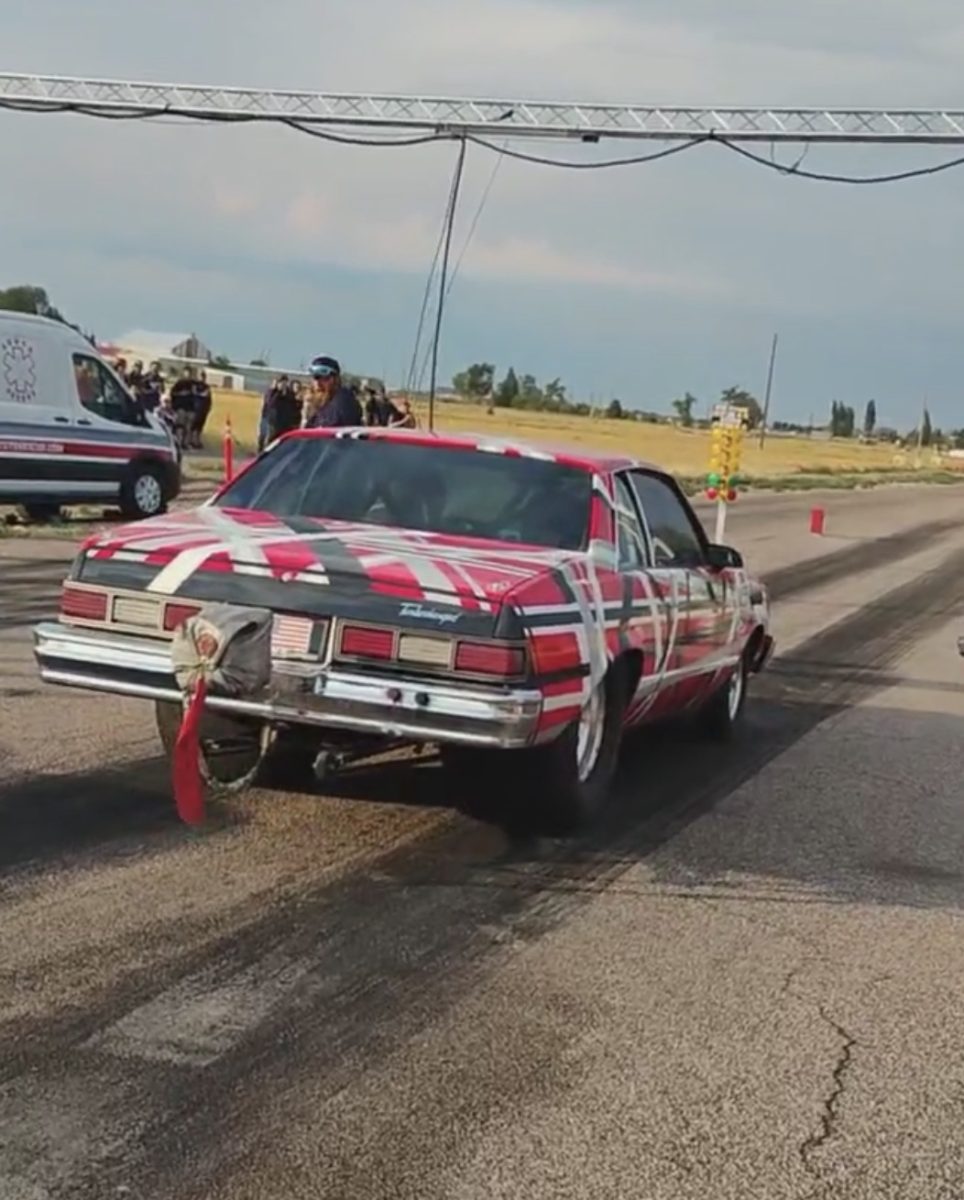
Thomas Tillotson, the president of South Hills Raceway (SHR), is in the process of acquiring land in Twin Falls County to build a permanent drag strip. A completion date for this project has not yet been established.
The drag strip is made up of pavement rolling with a cement box up to the 60-foot line, a timing marked 60 feet from the starting line that measures a vehicle’s initial acceleration and traction. Additionally, non-caustic chemicals are applied to the surface to protect the road, which are non-toxic to the environment.
Illegal street racing has no finish line; so, to provide a safe, legal form of street racing, Tillotson came up with a tangible finish line: eight miles, 660 feet of road, confined from start to finish, calling this ‘Outlaw Street Racers.’
Anyone and any car can participate in this drag strip; however, they must pass a rigorous inspection. Moreover, drivers also need a five-point harness, helmet, and proper clothing. An entry fee and liability sheet are required, as well.
Tillotson said, “I wanted to bring something excellent to the community; I worked a lot of time, energy, and money to come up with a way to bring [drag racing] in a safer form for Twin Falls County.”
Currently, SHR is in the process of acquiring property to build a permanent facility in the Magic Valley, where a mobile setup is not required. The mobile system consists of a bus that can be transported to any road and, in two hours or less, lay out a fully functional drag strip.
SHR is a non-profit organization committed to providing a safe, controlled environment to learn and share tips on car mechanics, modifications, safety, and the people’s passion for motorsports. SHR will also help curb illegal racing off the streets of our community by assisting law enforcement and road-safety groups in promoting proven road-safety initiatives.
“We worked on coordinates with the Twin Falls County representatives, and the Sheriff’s Department in the highway district to apprehend a legal place to do [street racing],”Tillotson said. “The whole idea wasn’t just to bring a predictable starting line,” Tillotson said, “but to remove the street racing from the public, to get it out into an area where the public wasn’t at risk, but at the same time, strengthening the relationship between the police and the car clubs, because the police don’t want to chase our clubs around, and the car clubs don’t want to be chased by police.”
“Our mindset is of a set that we want to help everybody make it to the top; we don’t like crossing the finish line alone,” Tillotson said. “We’re looking at vendors to come in so they can be supported, too. I’m a believer that it’s only a good deal if it works out for everybody involved.”
Food concessions and vendors are present at the drag strips; if a vendor wishes to sell food or merchandise, they go to Nate Tripplet, the SHR coordinator for vendors, who helps coordinate dates. A percentage of vendor sales goes to SHR to help cover the costs of running the operation.
“This is for the betterment of not only the sport of drag racing, but the safety of our community, and it’s about bringing up the new generation in a professional fashion that helps perfect the craft of drag racing and not distort or ruin relationships, or, even worse, possibly lives,” said Tillotson.
Hanna Muñoz • Apr 24, 2026 at 11:07 am
Isn’t it funny that to make people stop doing illegal activities, we have to legalize them? I love you Myaaaaaaa.